QUAIL MUTTERINGS #107.  The Many Faces of Death (September 2026)

           Having the freedom to write about practically anything I want to is such a gift. It allows me the time and space to contemplate and focus on what is really important and ponder how it relates to what is going on in our day-to-day lives. Exploring the interrelatedness of all things leads to many questions and perhaps a few answers. Through this process I’ve become aware that there are no absolutes, not really. Everything is shades of gray—with some bright spots of color here and there.

            Benjamin Franklin stated, “In this world nothing can be said to be certain, except death and taxes.” In our current reality this seems to hold true. However, the lens with which we view the world varies, from person to person as well as from the choices we make for how we look at any given thing. And that can be up to us.

            I’ll start with taxes. Most of us pay them over and over and over again. Others don’t, either by opting out of society all together, or are so poor that it’s not required, or are so wealthy that they can harness enough legal (or illegal) power to rise above the system, but I’m not here to talk about taxes.

            Then there’s death—with its many faces. Right now we are facing the death of summer, the end of our children’s vacation as they go back to school. Many look forward to it, but I certainly did not. I felt like a part of me was dying when school started again in the fall. Summer always had the feeling that time stopped, providing the space where endless opportunities could be revealed.

            Expiration dates. Credit cards, coupons, sales events… These things also die. As does our interest in the items we purchased with them. But that leads to another story.

            The end of our life here on earth can feel like the ultimate kind of death. It’s heart-wrenching for those of us left behind when a loved one departs. And obviously scary, sad and confusing for the one checking out.

            I visited my dear cousin who’s on hospice now. She’s still communicative, caring and friendly. She hides a lot of her anguish and anxiety, but it still comes through. Of course, tears come and go every day, and she wrestles with this. In spite of being comforted by her religion, she’s fearful, and rightfully so.

            There can also be a kind of death of ideas, or assumptions, that no longer prove to be true. Wouldn’t it be wonderful if we would each own up to the possibility of being wrong at the first inkling of doubt? Or maybe even prior to that—since it’s all shades of gray anyway. Just a thought.

            With the unwavering heat this summer, every thing and every one seems ready to snap. That’s what happened last night when a huge eucalyptus limb fell across our driveway, barely missing my car. Last week, a tree trimmer, commissioned by SDG&E, called and told me they needed to trim nine oak trees on our property. I explained how they had already done the work three months ago. After supposedly checking with his supervisor, he said that because it’s on the work order he needed to do it. I’d learned from a tree specialist that summer is the worst time to do this, so I responded.

“These old oaks are thoroughly stressed with the heat and lack of moisture. Cutting now would further stress them. Feel free to call back after it cools down and we get some rain.”

Hopefully he’ll look back over the records and find that the work was already taken care of. Someone has to protect our beautiful ancient oaks. I don’t want their death on my hands.

Dinosaurs experienced a massive death—extinction. Many species have followed suit and many more are on the endangered list. Some of these deaths are within our ability to prevent. Protecting them protects us. Life comes full circle. After all, everything is interrelated.          


Chi Varnado has published six books including fiction, nonfiction and children’s books. They are available on www.amazon.com. Her collection of essays, Quail Mutterings, can be found on www.chivarnado.com or www.dancecentrepresents.com.

She is available to adults and children for fun tutoring in writing.
QUAIL MUTTERINGS #106.  Stumbling Along the Salt Path (August 2026)

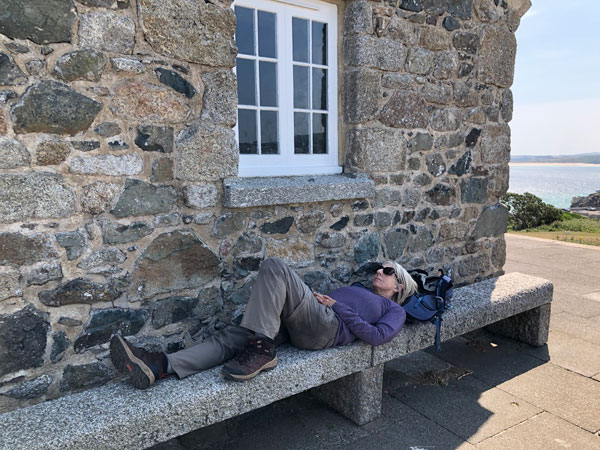
           Blustery winds, rugged terrain, exquisite turquoise beaches, and profusions of wildflowers can greet one at every turn along the Cornish Salt Path, or Coast Path as it is known locally. Up, up and away, and then down, down and onward, we trudged during the heatwave hovering over Western Europe this summer. When Kent expressed strong interest in taking a week of courses at the University of Cambridge, I thought about tagging on a hiking adventure, i.e., the Salt Path. My sister joined us, agreeing that this could be another grand adventure for the three of us.

            Cornwall boasts beautiful, unique scenery even in July. We hiked and hiked and hiked, usually eight or nine miles a day. And yes, there were blisters and bandades and tired legs. But whenever we passed other hikers, which wasn’t that often, they would say, “Hello,” in that melodic, sing-song British accent. Always polite.

Quali-Mutterings-106-Stumbling-Along-the-Salt-Path

            Here in the backcountry of San Diego County, we also have a plethora of absolutely amazing hiking trails. Of course, here during the summer months, it’s usually more enjoyable to start out very early in the morning and head back before the heat of the day sets in. We just have to be creative. And walking along is a great way to see and experience the natural environment of a place. It allows us to slow down and be in the moment.

            After a week it was on to Cambridge. While Kent attended lectures, Bo and I hiked to Grantchester, punted along the River Cam through the university, and meandered in the surrounding meadows, watching swans with their cygnets, blue herons, geese and ducks float by in the river. It really was quite idyllic.

            When I visit a new place I don’t usually read or watch movies because that would color the way I experience it. I want to feel its true essence as much as possible. One of the takeaways from there is how old the buildings are. Parts of the University of Cambridge were built as early as 1200 AD! We just don’t have anything like that here. Those walls have stood the test of time. Ours really don’t. And now I’m afraid that we’re all heading in the opposite direction.

It seems that nowadays we’re not happy with our own abodes for long. Time to remodel or add on or get the latest furniture… In the past large families existed fine with only one bathroom. Furniture was not replaced until it was worn out beyond repair. I was even taught to darn socks and I still do it if they are a nice pair and otherwise still serve their purpose. At least thrift stores, yard sales and hand-me-downs still exist and allow us to recycle and reuse. This mentality that we must have new is destroying our precious resources. I find a certain creativity in making do with less. I even get excited by interesting, out of the mainstream choices. But that’s just me, I suppose.

When a new business comes into town, wouldn’t it be better to occupy an already existing structure instead of building something new? At least the old K-Mart is coming back to life. Out with the old and in with the new? No. How about we give new life to the old?

Cell phones are manufactured to have a limited shelf life. I don’t consider my phone, an iPhone X, to be that old. But several apps no longer function and can’t be updated because of the software involved. Now this is a crime, as far as I’m concerned! I’m doing my best to not take part in this unsustainable behavior. Perhaps if enough of us take the initiative and refuse to buy in, then we can turn this insane practice around. Wouldn’t it be better for our planet Earth if things were built to last, and not require constant updating or buying new?

Perhaps it’s time to head back to the trail. Whether we’re traversing along ancient footpaths or forging new routes, just getting out there can help us to live better. And by this I simply mean to embrace the natural environment and shake off some of the modern contraptions, at least from time to time. I’ll try to remember those Cornish manners and give you a polite “Hello” when our paths cross.


Chi Varnado has published six books including fiction, nonfiction and children’s books. They are available on www.amazon.com. Her collection of essays, Quail Mutterings, can be found on www.chivarnado.com or www.dancecentrepresents.com.

She is available to adults and children for fun tutoring in writing.      

QUAIL MUTTERINGS #105.  What Gives? (June 2026)

“Me first!”

“My woofers are bigger than yours.”

“My taste in music is superior.”

I put my blinker on to change lanes and the car, more than a quarter mile behind, speeds up to prevent my doing so. Or I stop at a light and sense a heavy pulse ratcheting up my spine and shaking my cheek bones. Then the bass beat becomes unbearably loud. What gives?

I’m sorry to have to ask but, where have we gone wrong? When did it become publicly acceptable to force our choice of noise onto everyone else, whenever we feel like it? Even if they don’t choose it? Kent and I experienced this at an extreme level this weekend in a campground at the bay.

Quali-Mutterings-105-What-Gives

The place was packed, understandable since it’s now summer. We parked and got our dog out to walk around. Golf carts overloaded with teens raced by—speakers blaring their favorite raucous rap music. Around a corner I yanked Zelda out of the way of two young boys on E-bikes, careening out of control. Even they had loud music blasting from their handlebars. Not many regular bikes here that one actually has to pedal to move forward. Just lots of E-bikes, E-skateboards, E-scooters, E-Segways… each commanding its own trajectory and choice of ear-splitting noise to accompany them. Often, we couldn’t even hear our own conversation. By early evening it was deafening. The competing, amplified onslaught from campsites and people-moving machines produced a space of utter chaos.

Late that night, when the subtle bell tolled the beginning of quiet time, the incessant noise continued into the wee hours. One might wonder why the staff didn’t do anything about it. But as a teacher, and volunteer ranger, I know that you can’t really do much these days. It seems that everyone has to suffer now.

We left first thing this morning. Zelda, like us, was stressed. She hadn’t relieved herself in close to twenty-four hours and I was afraid we’d need to visit the veterinarian. However, once back at home she took care of business immediately. Whew.

Ahh, the peace and quiet of home sweet home. I could hear the birds singing in the canopy of oak trees as the breeze rustled the nearby leaves. Amazingly, nothing needed immediate attention (we usually have to hit the ground running) so we were able to unpack in a leisurely fashion. Even the best trips make us appreciate home once we’re back. Sometimes after just one night.

Then there’s the flip side to all the unconscious invasion of peace—like when adult children sever ties with their parents, siblings, cousins, aunts and uncles… There are situations in which this is, no doubt, justified. But you hear of it happening more and more, seemingly for rather shallow reasons. This is definitely a thing now. Often, evidently, millennials are being counseled to break family bonds. There is always work involved for any relationship to continue. The issue I see with the increase in this trend might point to a lack of muster: When the going gets tough… Not so much. Now that I think about it, it’s not the flip side of the aforementioned selfishness, but more of the same.

I believe that perhaps we’ve become obsessed with “boundaries” at the cost of working together. And our divided society, for the most part, encourages this. The term toxicity is being thrown around like never before—all in the name of instilling the perceived need for barriers instead of building bridges. How can we always think that it’s someone else’s fault? It’s quite a sad state of affairs.

Wouldn’t the world, as well as our families and communities, be a better place if we focused more on inclusivity? What about that neighbor who pitches in without hesitation? Or the grandmother who volunteers her time to watch the grandkids, bring meals, run errands…? How about doing something nice to show appreciation instead of a barely audible, “Thank you?”  

  On a semi-regular basis I try to reach out to those who might like some company. It also feeds my soul. Sometimes we may question why we’re not the ones who are getting reached out to as often. But we each have our own life story to deal with and I’m not here to judge. I’m just thrilled when it does happen for me, however, one can never count on it. Besides, we’re much better off with regular connections regardless of who initiated what.

There have been studies done which prove that longevity is directly related to our regular social engagement. It outperforms healthy eating, solo mental gymnastics, and physical exercise. Think of our chances of living longer, and better, if we combine all of them—along with lots of laughter, of course.

So let’s get together – yeah, yeah, yeah!


Chi Varnado has published six books including fiction, nonfiction and children’s books. They are available on www.amazon.com. Her collection of essays, Quail Mutterings, can be found on www.chivarnado.com or www.dancecentrepresents.com.

She is available to adults and children for fun tutoring in writing.